
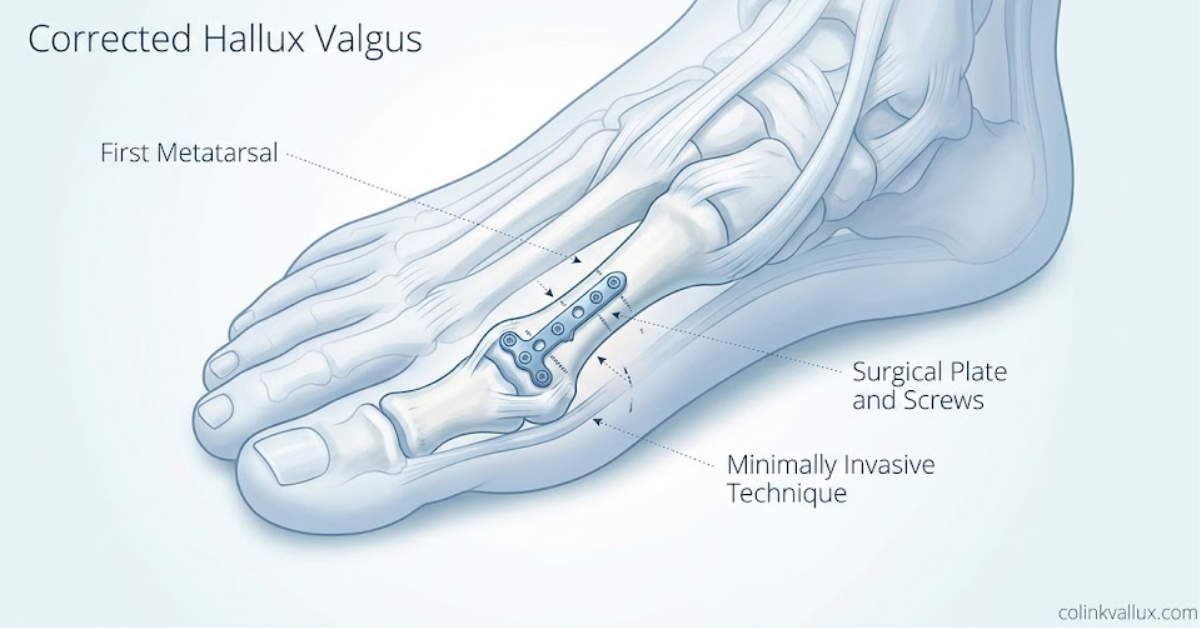
Bunions are one of the most common foot deformities, and for years patients facing moderate to severe cases had limited options beyond traditional open surgery. This is where colinkvallux.com comes in, offering information about the CoLink Vallux Active Bunion procedure, a modern, minimally invasive approach to bunion correction developed by In2Bones and now part of CONMED’s fixation portfolio.
What Is the CoLink Vallux Active Bunion Procedure?
The CoLink Vallux Active Bunion is a joint-sparing, minimally invasive surgical technique designed to correct hallux valgus, more commonly known as a bunion. Unlike older approaches that often require fusing the midfoot joint, this procedure uses a guided translational osteotomy along with a zero-prominence plate and a choice of locking and non-locking screws to realign the joint in multiple dimensions without restricting its natural movement.
Because the technique avoids joint fusion, it is intended to preserve the foot’s full range of motion while still correcting the underlying misalignment that causes the bunion to form.
How It Differs From Traditional Bunion Surgery
Several features set this approach apart from conventional bunion correction methods, such as the Chevron osteotomy:
- Smaller incision: Typically 1–2 cm, compared with the 5–7 cm incision often required for open procedures.
- Shorter surgery time: The procedure can often be completed in around 20 minutes, versus 40–60 minutes or more for more invasive techniques.
- Joint preservation: The joint is not fused, which is intended to help maintain normal foot mechanics after healing.
- Reduced scarring: A smaller incision may lead to less internal scarring and, in some cases, less post-operative stiffness.
What Patients Should Know Before Considering It
While the minimally invasive nature of this procedure offers several potential advantages, no surgical technique is a one-size-fits-all solution. Suitability depends on factors like the severity of the bunion, overall foot structure, and a patient’s general health. As with any orthopedic procedure, recovery experiences can vary from person to person, and outcomes depend heavily on the surgeon’s experience with the technique.
Anyone considering bunion correction surgery, including the CoLink Vallux Active Bunion procedure, should have a detailed conversation with a qualified orthopedic foot and ankle surgeon. A proper evaluation, including imaging and a physical assessment, is essential to determine whether this or any other surgical option is the right fit.
Recovery and Aftercare
Because the procedure avoids fusing the joint, many patients may be able to return to weight-bearing activity sooner than they would after more invasive corrections, potentially with less physical therapy involved. That said, recovery timelines should always be discussed directly with the treating surgeon, since individual healing rates and post-surgical instructions can differ significantly.
Final Thoughts
For patients researching modern options for bunion correction, resources like colinkvallux.com can provide a helpful starting point for understanding how the CoLink Vallux Active Bunion procedure works. However, this information should complement, not replace, a consultation with a licensed foot and ankle specialist who can evaluate individual circumstances and recommend the most appropriate treatment plan.
Also Read More Articles At: baccaratonlinebaccarat.net