
Most leather jackets are not destroyed by wear. They are destroyed by the five months a year nobody is wearing them.
A jacket goes into a wardrobe in April looking fine and comes out in October with a shoulder ridge that will not brush out, a musty smell, a chalky white bloom across the chest, or hardware that has stained the leather underneath it. None of that happened while it was being used. It happened in the dark, slowly, because of a wire hanger and a plastic bag.
Leather is a natural material with oils in it. It keeps reacting to air, moisture, pressure, and temperature long after you stop wearing it. Storage is not passive; it is just slow.
Here is how to put a jacket away so that the next season starts where the last one ended.
Clean It Before It Goes Away, Not After
This is the step almost everyone skips, and it causes more damage than any other mistake.
Body oils, sweat salts, food residue, and dust are all sitting on the leather when you hang it up. Over months in a warm cupboard, those substances break down the finish, feed mould, and set into permanent marks. A stain that would have wiped off in April becomes part of the jacket by September.
What to do before storing:
- Empty every pocket. Receipts and coins leave outlines. A forgotten pen is a disaster.
- Wipe the whole surface with a barely damp cloth, then let it air dry naturally.
- Pay attention to the collar, cuffs, and underarms, the three contact points that collect the most body oil.
- Deal with stains now. A specialist leather cleaner, tested on a hidden seam first, beats hoping it will fade.
- Let it dry completely. Even slight dampness sealed in a cover for months means mould.
If the jacket had a genuinely hard season, professional leather cleaning once a year is a reasonable expense. It is considerably cheaper than replacement.
Condition Lightly But Do Not Overdo It
Conditioning replaces the natural oils leather loses through wear and time. Before a long storage period, a light application helps the leather stay supple rather than drying out.
The mistake is applying too much. Over-conditioned leather goes sticky, attracts dust, and can develop a greasy surface that darkens unevenly.
- Use a thin, even coat of a quality leather conditioner or cream.
- Work it in with a soft cloth in small circular motions.
- Let it absorb for several hours, then buff off any excess.
- Once before storage is plenty. Twice a year total is enough for most jackets.
Skip this step entirely if your jacket has a heavy pigmented or patent finish; those surfaces are sealed and cannot absorb conditioner. It will just sit on top.
The Hanger Is Not a Small Detail
A leather jacket has real weight, and it hangs from two narrow points for months. The hanger decides whether it keeps its shape.
Never use wire hangers. They concentrate the entire weight of the jacket onto two thin lines, creating permanent shoulder dents and sometimes rust marks.
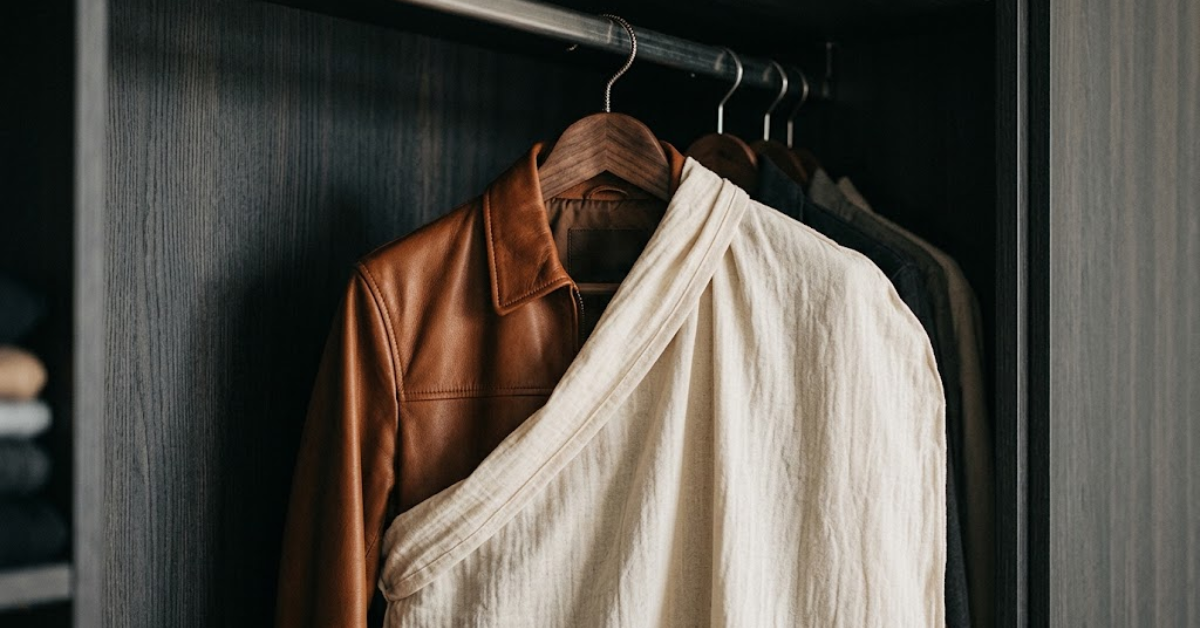
Use a broad, contoured wooden hanger wide enough to fill the shoulders fully. The hanger should support the shoulder seam edge to edge, mimicking the shape of actual shoulders. Padded hangers work well too.
Heavier jackets deserve more support. A thick cowhide biker jacket or a leather jacket with hood carries extra weight high on the garment, so a wider hanger with a deeper shoulder curve prevents that load from pulling the leather out of shape at the seams.
A few more rules:
- Zip or button it up. A closed jacket holds its front panels in line. An open one splays and distorts over time.
- Hang it, never fold it. Folded leather develops creases that set into cracks. Short-term travel folding is one thing; five months is another.
- Give it space. Crammed between winter coats, a jacket gets compressed and cannot breathe. Leave a few centimetres of air on either side.
Cover It With Cotton, Never Plastic
The dry cleaning bag is the most common storage mistake in existence.
Plastic seals the leather off from air. Leather needs to breathe; it continually exchanges small amounts of moisture with its surroundings. Trapped in plastic, that moisture has nowhere to go, and you get mildew, a musty smell, and sometimes a sticky, degraded finish.
Plastic also traps heat, which accelerates the breakdown of the leather’s oils.
Instead, use a breathable cotton or canvas garment bag. It keeps dust off, blocks light, and still allows air movement. An old cotton bedsheet draped over the jacket works fine if you do not want to buy anything.
If the jacket came with a cloth bag from the brand, that bag exists for exactly this reason.
Pick the Right Spot in the House
Where you store it matters as much as how.
Avoid:
- Attics and basements. Temperature swings and humidity extremes are the two worst things for leather.
- Direct sunlight. UV fades dye unevenly and dries the surface out. A jacket stored near a sunny window will show a lighter panel on the exposed side.
- Near radiators or heating vents. Dry heat pulls moisture from the fibres and causes cracking.
- Damp cupboards against exterior walls. These often run humid without you noticing.
Aim for a cool, dark, well-ventilated interior wardrobe with a stable temperature. Roughly 10–21°C and moderate humidity around 40–50 percent is the comfortable range. If your home runs very humid and coastal or monsoon climates often do, a few silica gel packets in the wardrobe help, as long as they are not touching the leather directly.
Do not use mothballs on leather. The chemicals can affect the finish, and the smell is extremely difficult to remove.
Check on It Halfway Through
A jacket left untouched for six months is a jacket you find out about too late.
Once during the off-season, take it out and spend five minutes on it:
- Look for any white or greenish bloom, which signals mould starting.
- Check the lining for a musty smell.
- Make sure the shoulders have not developed a ridge from the hanger.
- Let it hang in open air for an hour before putting it back.
Mould caught in week ten wipes off with a slightly damp cloth and thorough drying. Mould discovered in month five has usually stained the leather.
Bringing It Back Out
Do not just pull it on and walk out the door.
- Air it for a full day on a hanger, ideally somewhere with light airflow but not direct sun.
- Check for stiffness. Gently flex the sleeves and hem. Movement redistributes the oils.
- Condition if it feels dry with a light coat, same as before storage.
- Deal with light creases by hanging it in a steamy bathroom for fifteen minutes. Never apply an iron directly. If you must press, use low heat, a thick cloth barrier, and keep moving.
- Buff the hardware with a dry cloth if any tarnish has developed.
A jacket stored properly usually needs nothing more than an afternoon on a hanger.
FAQ
Can I store a leather jacket in a vacuum bag to save space?
No. Vacuum bags compress leather flat and remove the air it needs, producing deep permanent creases and potentially cracking the finish. They are made for down and knitwear, not leather. If wardrobe space is genuinely tight, hang the jacket somewhere else in the house rather than compressing it.
How often should I condition a jacket that is in storage?
Once before you put it away and once when you take it out is enough for most jackets. Conditioning more frequently during storage causes oil buildup, which attracts dust and can darken the leather unevenly. Very dry climates may justify a light third application mid-season.
Is it bad to store a leather jacket in a basement or garage?
Yes, in most cases. Both spaces typically swing between temperature and humidity extremes, which is the fastest route to mould, stiffening, and cracked finishes. An interior wardrobe on an upper floor is far safer, even if the hanging space is tighter.
My jacket already smells musty; can it be fixed?
Often, yes. Hang it in a well-ventilated area out of direct sun for a few days. A cloth bag of activated charcoal or baking soda nearby, not touching the leather, absorbs odour. If the smell comes from the lining, a light wipe with a cloth dampened with diluted white vinegar, followed by thorough air-drying, usually clears it. Persistent odour means professional cleaning.
Do suede and nubuck jackets need different storage?
The core rules are identical: breathable cover, broad hanger, stable environment. The differences are that suede should be brushed with a suede brush rather than wiped, and it must never be treated with standard leather conditioner, which flattens the nap permanently. Suede is also more vulnerable to humidity, so ventilation matters even more.
Final Thought
Off-season storage is the least interesting thing you will ever do with a leather jacket, and it has more influence on how long that jacket lasts than almost anything else.
The whole routine takes under an hour: clean it, condition it lightly, hang it on something broad, cover it in cotton, and put it somewhere cool and dark. One mid-season check, one day of airing when it comes back out.
A jacket that gets that treatment every year does not just survive. It ages the way good leather is supposed to: softer, richer, and more yours each season. The jackets that crack and stiffen are almost always the ones that spent their summers in a plastic bag on a wire hanger.